• Cross Rip Lightship – Winter, 1918

    Scuttlebutt

    / ,


    From 1958 to 1962, our Overfalls was assigned to Cross Rip Lightstation in the middle of Nantucket Sound. The history of Cross Rip Station shows that it was a particularly hazardous location for a lightship to endure. From 1826 to 1953, twelve different lightships served here. Many collisions were reported and two ships were lost.
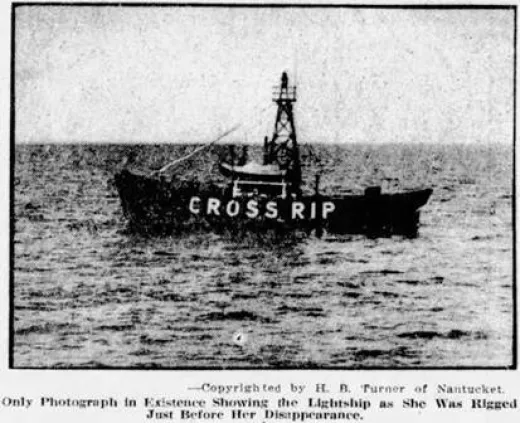
    In 1915 LV-6 was assigned to Cross Rip. LV-6 was built in 1855 as an 80-foot wood-hulled coastal schooner. In 1915 its masts were removed and replaced with an iron skeleton to display its light before being assigned to this hazardous shoal. The ship lacked any modern features of the era, operating without an engine, sails, or a wireless radio.


    The winter of 1918 was a particularly brutal one. By late January, Nantucket Sound was completely frozen over. This rare occurrence meant no shipping could traverse the Sound, making the Cross Rip lightship’s mission irrelevant. In the same freeze three other lightships in the area were stuck in pack ice as well. Two were able to steam out under their own power and one was towed free from the ice. LV-6, however, was too far out in the ice for any rescue vessels to reach her and her condition was not good. The lightship’s captain was on shore leave at the time so First Mate Henry F. Joy, was in command. The ice was so thick that Joy was able to walk across seven miles of sea ice to Nantucket Village in order to ask permission to abandon ship. He was ordered by the local USLHS District Officer to return to his ship and maintain station. Some reports indicate that Joy was actually reprimanded for leaving his ship. On February 4 the pressure of the ice pack around the Cross Rip caused her to part her mooring cables. Rising temperatures thawed the ice which started to move with the strong tidal currents, carrying the trapped lightship out to sea. On February 5, the light-keeper at Nantucket’s Great Point light spotted the trapped ship sliding helplessly out of the Sound, into the open Atlantic. Her ensign was flying upside down, the maritime signal of extreme distress.

    The lightship and her crew were never seen again.
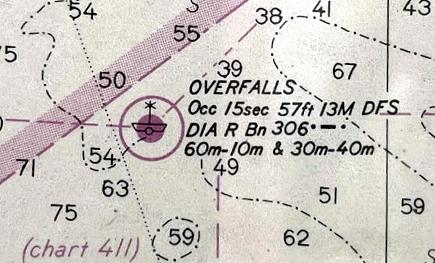

  • Overfalls Lightstation in 1957

    If you can find a Delaware Bay nautical chart from years ago, you may be able to discover the location of the Overfalls Lightship (about 3 miles due east of Cape Henlopen). This detail of a section of a 1957 chart shows that location. If you look closely at the image printed on the chart though, there is actually a lot more information than just the location of the ship.

    Here is how to decipher all of the lightstation information shown on the chart:

    • OVERFALLS – The ship’s name that is printed in big block letters on her hull.

    • Occ 15sec – This means she had an “occulting” light. This is not a flashing light, but one that would have an on/off cycle of 15 seconds.

    • 57ft 13M – The light on top of the mast was 57 feet above the waterline and was visible from 13 miles away.

    • DFS – Overfalls was a “Distance Finding Station.” Her radio beacon was broadcast to coordinate with her foghorn. This gave ships a way to calculate a bearing and their distance from her.

    • DIA R Bn 306 ●▬● – She had a diaphone style foghorn (two tones) and a radio beacon that broadcast a dot dash dot pattern on 306Khz.

    • 60m-10m & 30m-40m – The radio beacon was broadcast on this schedule (on the hour and at 10, 30 and 40 minutes after the hour) giving shipping the ability to coordinate their radio watches.

    Probably WAY more than you wanted to know…


  • Overfalls Has New Life Rings

    If you come for a visit to Overfalls this summer, check out the new life rings we have onboard! They are located on the upper or “weather” deck. The previous life rings were over ten years old. Time had taken its toll and replacement was needed. You might want to make special note of the lettering we chose to use on the new life rings: USLHS – LS118.

    The sinking of the Titanic in 1912 inspired the first International Convention for the Safety of Life at Sea (SOLAS), where representatives of over 100 countries collaborated to propose a treaty specifying minimum standards for ship construction, equipment and operation. The first version of these specifications was adopted in 1914, and it has been periodically updated through the years. Today’s SOLAS lettering specifications for lifesaving equipment states that it must be lettered with the ship’s name and port of registry; in 1938, when the Overfalls was launched, those lettering requirements did not exist.

    The earliest documentation that we have for our ship is the 1936 specifications book that the United States Lighthouse Service (USLHS) provided to Rice Brothers Shipyard in Maine, where she was built. The various labeling specifications outlined in that book – including those for the lettering of life rings – stipulate that “USLHS – LS118” be used. Although Overfalls is, by and large, displayed as she came off station over 50 years ago, it is nice to give a nod to her origins.


  • The 1934 Sinking of the Nantucket Lightship

    In 1934, the ocean liner Olympic rammed and sunk the Nantucket lightship.

    Sinking of the Nantucket lightship video


  • Man Overboard Lights

    Scuttlebutt

    / ,

    There are several life rings located on the Overfalls weather deck. These rings were to be tossed to someone who had fallen overboard. Right beside each life ring is something that looks like a large mustard-colored flashlight. These are man overboard rescue lights. They are battery powered and are designed to be tossed, with the life ring, to the person who has fallen in. It’s interesting to note that they are mounted upside down in their holders. They are weighted so that when they enter the water they invert and float upright. A switch inside automatically turns the light on when it inverts to help show the location of the life ring in the water at night.


  • So What Kind of Clock Is That?

    Scuttlebutt

    / ,

    Located above the helm on Overfalls, this is a 24 hour Chelsea Clock. The United States military uses 24 hour timekeeping because it make it easier to differentiate between AM and PM. Two thirty in the morning is 0230 hours (usually referred to as “o-two-thirty”). Two thirty in the afternoon is 1430 (or “fourteen-thirty”). This avoids confusion about what time one needs to do something but it takes some getting used to. Obviously the face of the clock on our bridge takes some getting used to as well. The picture above shows the time as just shy of 10:20 in the morning.

    We have three mechanical Chelsea clocks on board Overfalls and one of the routine duties of someone who was on watch was to keep the clocks wound. The seaman on duty would have to note in the log that he “wound escapement clocks”. The term escapement clock simply refers to any spring wound mechanical clock.

    The Chelsea Clock Company was founded back in 1884 but still manufactures clocks at its factory just outside of Boston in Chelsea, Massachusetts. Like many companies during WW2, they shifted much of their production to government contacts, providing clocks for most all Navy and Coast Guard vessels of the day.


  • What on earth is that?

    CP-95/PD

    This is an artifact from the Cold War and was on LV118 when she arrived in Lewes in 1973. The CP-95/PD (commonly called a Radiac unit) was used to read the amount of radiation an individual had been exposed to. A small pendant on a chain (a “personnel dosimeter”) would be worn around the neck of an individual to be monitored. After exposure, the dosimeter would be placed inside the Radiac unit and the “ROENTGENS” meter would read the amount of radiation to which the wearer had been exposed. This particular unit dates from the early 1960’s.