Our area has a fascinating history filled with unusual (and sometimes spooky) stories. Throughout the year, WBOC’s Bill Mich has been tracking down some of these stories and looking into reported haunted locations on the Delmarva Peninsula. Working with a paranormal investigator, he and his team visited six of them – including the Overfalls!
Find out what they discovered by tuning in the Delmarva Sports Network for the special featureSpirts of the Shore airing multiple times starting at 9 PM October 29 through November 1. The segment will also be available to stream on WBOC and shared on WBOC’s Facebook page. Don’t miss it!
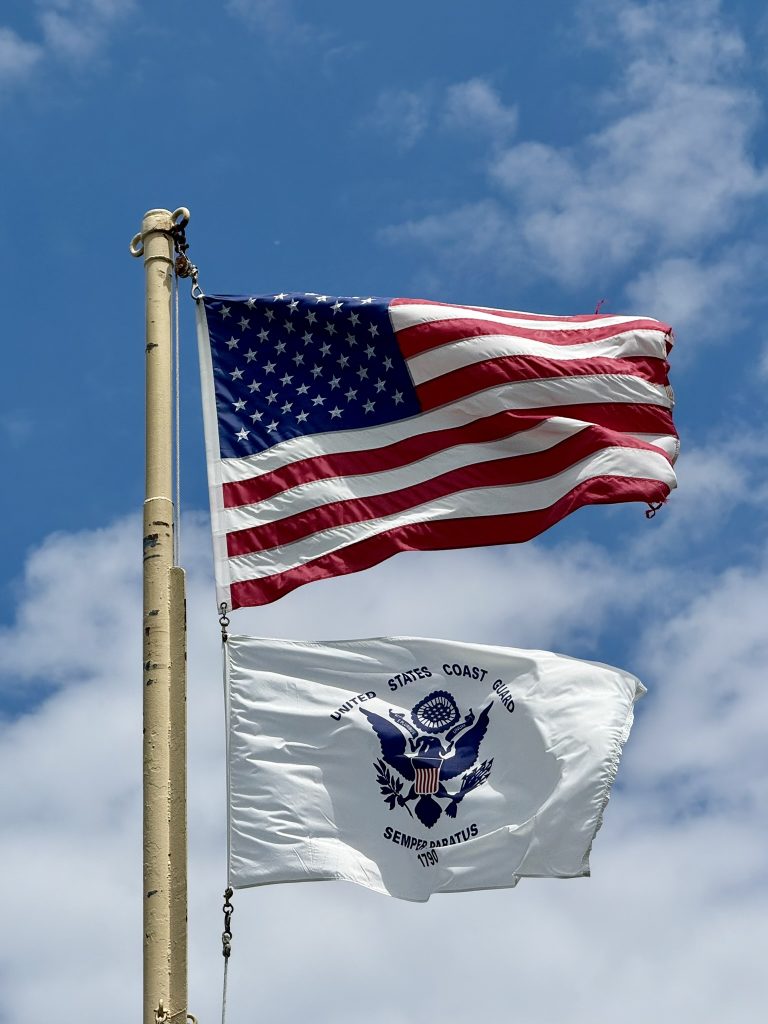
In the early days of the American republic, the young nation faced a serious problem: smuggling was draining its revenue. To combat this, Alexander Hamilton proposed a fleet of cutters to patrol the coast and enforce tariff laws. On August 4, 1790, Congress approved the creation of the Revenue Marine, later known as the Revenue Cutter Service—the earliest ancestor of today’s Coast Guard.
These cutters weren’t just tax enforcers. They chased pirates, rescued stranded sailors, and even intercepted slave ships. For nearly a decade, they were the only naval force protecting U.S. waters.
1915 – A New Identity
Fast forward to 1915, when Congress merged the Revenue Cutter Service with the Life-Saving Service, forming the United States Coast Guard. This new organization combined law enforcement with humanitarian rescue missions—a dual identity that remains its hallmark today.
Expanding the Mission
The Coast Guard’s responsibilities grew rapidly:
In 1939, it absorbed the Lighthouse Service, taking charge of America’s beacons and buoys.
In 1946, it took over the Bureau of Marine Inspection and Navigation, overseeing merchant vessel safety and licensing.
By 1967, it had moved to the Department of Transportation, reflecting its growing civil role.
As Guardians of the Sea the Coast Guard used lightships like our Overfalls
Not all hazards could be marked by lighthouses—some waters were too deep or remote. Enter the lightship: a floating lighthouse anchored offshore to warn mariners of dangerous shoals, reefs, and harbor entrances. The Coast Guard maintained these floating sentinels until they were gradually replaced by automated buoys and modern navigation systems in 1985.
Wartime Service
Though often seen as a peacetime force, the Coast Guard has served in every major U.S. conflict. During wartime, it operates under the Department of the Navy, providing convoy escorts, beach landings, and port security. Its agility and versatility make it a vital military asset.
2003 – Homeland Security Era
After 9/11, the Coast Guard was transferred to the newly formed Department of Homeland Security in 2003. Its focus sharpened to include Counter terrorism, Port and coastal security, drug interdiction, and Environmental protection
Today, the Coast Guard is a military service, a law enforcement agency, and a lifesaving force. With over 40,000 active-duty personnel, it patrols more than 95,000 miles of U.S. coastline and responds to thousands of emergencies each year.
Its motto, Semper Paratus—“Always Ready” is more than a slogan. It’s a promise.
As a Family Member of the Coast Guard and one of the most celebrated survivors of the lightship era the Lightship Overfalls (Lightship #118), and its many supporters wish the United States Coast Guard Happy Birthday.
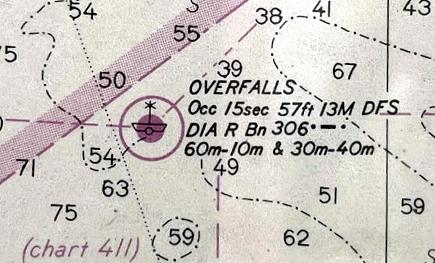
If you can find a Delaware Bay nautical chart from years ago, you may be able to discover the location of the Overfalls Lightship (about 3 miles due east of Cape Henlopen). This detail of a section of a 1957 chart shows that location. If you look closely at the image printed on the chart though, there is actually a lot more information than just the location of the ship.
Here is how to decipher all of the lightstation information shown on the chart:
• OVERFALLS – The ship’s name is printed in big block letters on her hull.
• Occ 15sec – This means she had an “occulting” light. This is not a flashing light, but one that would have an on/off cycle of 15 seconds.
• 57ft 13M – The light on top of the mast was 57 feet above the waterline and was visible from 13 miles away.
• DFS – Overfalls was a “Distance Finding Station.” Her radio beacon was broadcast to coordinate with her foghorn. This gave ships a way to calculate a bearing and their distance from her.
• DIA R Bn 306 ●▬● – She had a diaphone style foghorn and a radio beacon that broadcast a dot dash dot pattern on 306Khz.
• 60m-10m & 30m-40m – The radio beacon was broadcast on this schedule (on the hour and at 10, 30 and 40 minutes after the hour) giving shipping the ability to coordinate their radio watches.
Passed down through generations of sailors, fishermen, merchant mariners, and navies around the world, the centuries-old “Blessing of the Fleet” ceremony is intended to safeguard crews and their ships. On May 18th, Deacon Al Barros was called upon to deliver Lewes’ annual Blessing of the Fleet. This year, the Lightship Overfalls was also honored by being part of the ceremony. Included in the observance was a remembrance of JB Walsh, and Captain H. Dale Parsons by the floating of two wreaths honoring two local mariners who “crossed the bar” this past year. The parade of boats that followed was a powerful and impressive tribute, reflecting the deep respect and admiration held for these beloved members of our maritime community.
Jeremy D’Entremont with the United States Lighthouse Society hosts the weekly Light Hearted Podcast. Light Hearted Episode number 298 takes a look at the history of Overfalls and features an interview with Overfalls curator John Bolster.
Keeping an 80 year old wooden boat in working condition is an ongoing project. Our Monomoy lifeboat is kept in great condition by a dedicated group of volunteers who maintain and refurbish her. Here, Tommy Lynch works on the bottom in preparation for replacing some tired planks. Tommy is usually found at the Momomoy’s helm during the Lewes July 4th boat parade.
The election of new members to the Board of Directors of the Overfalls Foundation will take place at the Foundation’s Annual Meeting, pursuant to Section I of the Foundation’s Bylaws, as follows:
“The Annual Meeting of the Foundation shall be held on such date, hour, and place as may be designated by the President and the Board. The Secretary of the Foundation shall provide written notice of the annual meeting to the members not less than 30 days before the date fixed for the meeting. Those present in person at the annual meeting shall constitute a quorum.”
The President and Board have determined that the next annual meeting will be held on October 17, 2024, beginning at 5:00 pm, at the Lewes Public Library in the large meeting room. The Board- approved candidates are:
Cindy Castellana
Robert John “Bob” Petrow
Al Cybart
Patty Jackson
J. Patrick Lynch
Matthew Kennedy
Additional nominations may be made by Overfalls Foundation members in good standing from the floor at the meeting.
Notice respectfully submitted by:
David Shook Secretary Overfalls Foundation September 15, 2024
New life ring (on left) with the originally specified lettering
If you come for a visit to Overfalls this summer, check out the new life rings we have onboard! They are located on the upper or “weather” deck. The previous life rings were over ten years old. Time had taken its toll and replacement was needed. You might want to make special note of the lettering we chose to use on the new life rings: USLHS – LS118.
The sinking of the Titanic in 1912 inspired the first International Convention for the Safety of Life at Sea (SOLAS), where representatives of over 100 countries collaborated to propose a treaty specifying minimum standards for ship construction, equipment and operation. The first version of these specifications was adopted in 1914, and it has been periodically updated through the years. Today’s SOLAS lettering specifications for lifesaving equipment states that it must be lettered with the ship’s name and port of registry; in 1938, when the Overfalls was launched, those lettering requirements did not exist.
The earliest documentation that we have for our ship is the 1936 specifications book that the United States Lighthouse Service (USLHS) provided to Rice Brothers Shipyard in Maine, where she was built. The various labeling specifications outlined in that book – including those for the lettering of life rings – stipulate that “USLHS – LS118” be used. Although Overfalls is, by and large, displayed as she came off station over 50 years ago, it is nice to give a nod to her origins.